
Common Orthodontic Problems We Treat in Hershey, PA
Reviewed by Dr. Susan Korch, DMD, MS
The most common orthodontic problems are overjet (upper front teeth too far forward), deep overbite (upper teeth overlapping the lower too far), crossbite (upper teeth biting inside the lower), open bite (front teeth that do not meet), crowding, spacing, and underbite (lower teeth in front of upper). Nearly all are correctable with braces or clear aligners, and most are easier to treat when they are caught early.
Very few people are born with naturally straight teeth and a bite that meets correctly. When the teeth and jaws do not fit together properly, the technical name is malocclusion, which simply means “bad bite.”
It is worth knowing that this is not only about how a smile looks. A bite that does not meet properly affects how efficiently you chew, how easy your teeth are to keep clean, and occasionally how you speak. Those consequences accumulate quietly over decades.
Below is what each of the common problems actually is, what it causes if left alone, and how it is corrected.
Upper Front Teeth Protrusion (Overjet)
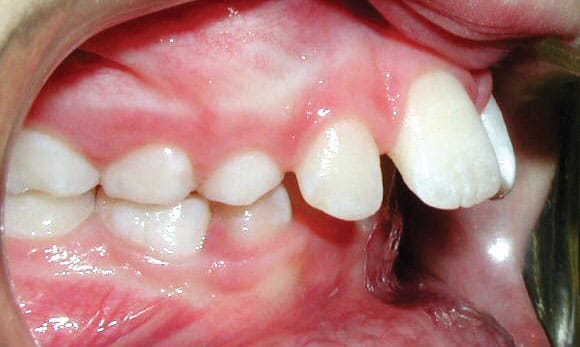
The upper teeth sit farther forward than ideal, or the lower jaw sits farther back. This can affect both appearance and function while increasing the risk of injury because the front teeth are more exposed.
Why it matters
Protruding front teeth are more susceptible to chips, fractures, and trauma during falls or sports activities.
Deep Overbite

The upper front teeth overlap the lower teeth more than normal. In severe cases, the lower teeth may contact the roof of the mouth.
Why it matters
An excessive overbite can wear down tooth enamel, irritate gum tissue, and place unnecessary stress on the teeth over time.
Crossbite

A crossbite occurs when one or more upper teeth bite inside the lower teeth instead of slightly outside them.
Why it matters
Crossbites can wear teeth unevenly and may cause the lower jaw to shift sideways to find a comfortable bite. Over time, this can affect facial symmetry and jaw development.
Open Bite

With an open bite, the front teeth do not touch when the back teeth are together, leaving a visible gap.
Why it matters
Open bites make biting into foods more difficult and are often associated with tongue-thrust habits that may require additional therapy during treatment.
Crowding

Crowding develops when there isn’t enough room in the jaw for all of the teeth to fit properly.
Why it matters
Crowded teeth are harder to brush and floss, increasing the risk of plaque buildup, tooth decay, and gum disease.
Spacing

Spacing refers to gaps between teeth caused by jaw size, missing teeth, or naturally small teeth.
Why it matters
While often cosmetic, larger spaces can trap food and allow neighboring teeth to drift into empty areas.
Underbite

An underbite occurs when the lower teeth sit in front of the upper teeth because the lower jaw extends farther forward.
Why it matters
Underbites can affect chewing, speech, and jaw function. Early treatment is especially beneficial because jaw growth can often be guided during childhood.
Overbite or Underbite? The Difference
These two get confused constantly, so here is the distinction in one line each.
| What you see | What is happening | |
|---|---|---|
| Overbite | Upper front teeth cover the lower ones too much | Almost everyone has some overbite, which is normal. It becomes a problem when it is excessive |
| Underbite | Lower front teeth sit in front of the upper ones | The lower jaw sits forward relative to the upper. Never normal at any degree |
The practical difference: an underbite usually involves jaw position rather than tooth position, so it benefits far more from early treatment while a child’s jaw is still growing. An overbite can often be corrected at any age.
What Causes a Bad Bite?
Some of it is inherited, and some develops. The usual contributors:
- Thumb sucking or prolonged pacifier use, which can push the upper front teeth forward
- Losing baby teeth too early, often to decay, which lets neighboring teeth drift into the space
- Injury to the mouth or jaw
- Differences in how the teeth or jaws develop
- Tongue thrust or low tongue posture, where the tongue rests or pushes against the front teeth
- Gum disease, which can allow teeth to shift in adults
Most of these are outside anyone’s control, and none of them is anyone’s fault. What matters is what is done about them.
Do I Actually Need Treatment?
Some signs are worth an evaluation, and none of them commits you to anything:
- Teeth that are crowded, overlapping or visibly out of line
- Front teeth that do not meet when you bite
- Biting your cheek or the roof of your mouth
- Jaws that click, pop, or feel tired
- Difficulty chewing on one side
- A jaw that shifts to one side when you close
- Losing baby teeth much earlier or later than expected
The first exam is free, and if you do not need treatment, we will tell you so.
How These Are Corrected
Nearly every problem on this page is treated with the same tools: braces, clear aligners, and occasionally an appliance that guides jaw growth in a child.
What differs is the plan. Dr. Korch uses 3D imaging to see tooth roots and jaw position before treatment begins, which matters most for crossbites and underbites, where the problem is not only where the teeth are but where the jaw is.
We treat patients from Harrisburg, Hummelstown, Palmyra, Middletown, Lebanon, Annville and Elizabethtown.
Find Out What Is Going On
An examination will tell you exactly which of these you have, whether it needs treating, and what it would take.
Korch Orthodontics · 357 West Governor Road, Hershey, PA 17033 · (717) 533-7400
Request an appointment. Your first exam is free.
Frequently Asked Questions
Have questions about orthodontic treatment? You’re not alone. Here are answers to some of the most common questions patients ask about orthodontic problems, treatment options, timing, and what to expect throughout your smile journey.
Which orthodontic problems should be treated early?
Crossbite, underbite and severe crowding benefit most from early evaluation, because all three involve jaw growth that can be guided while a child is still developing. The American Association of Orthodontists recommends a first evaluation at about age 7 for this reason. See early orthodontic treatment.
Is an overbite always a problem?
No, and this is widely misunderstood. A small overbite is normal and desirable. It only needs treating when the overlap is excessive, when the lower teeth are contacting the palate, or when it is wearing the lower front teeth.
Can crowded teeth be fixed without removing any?
Often, yes. Modern treatment creates space by expanding the arch or by slight reshaping between the teeth, and extraction is much less common than it once was. Whether it is possible in your case depends on how much space is missing.
My bite has changed and I am an adult. Is that normal?
Change is common, but it is not something to ignore. Adult bite change usually comes from teeth drifting after a loss, from gum disease loosening support, or from relapse after earlier orthodontic treatment. See adult orthodontics or, if you wore braces before, treatment for shifted teeth.
